


Disclosure Day

A Familiar Light in the Sky, Dimmer Than Before
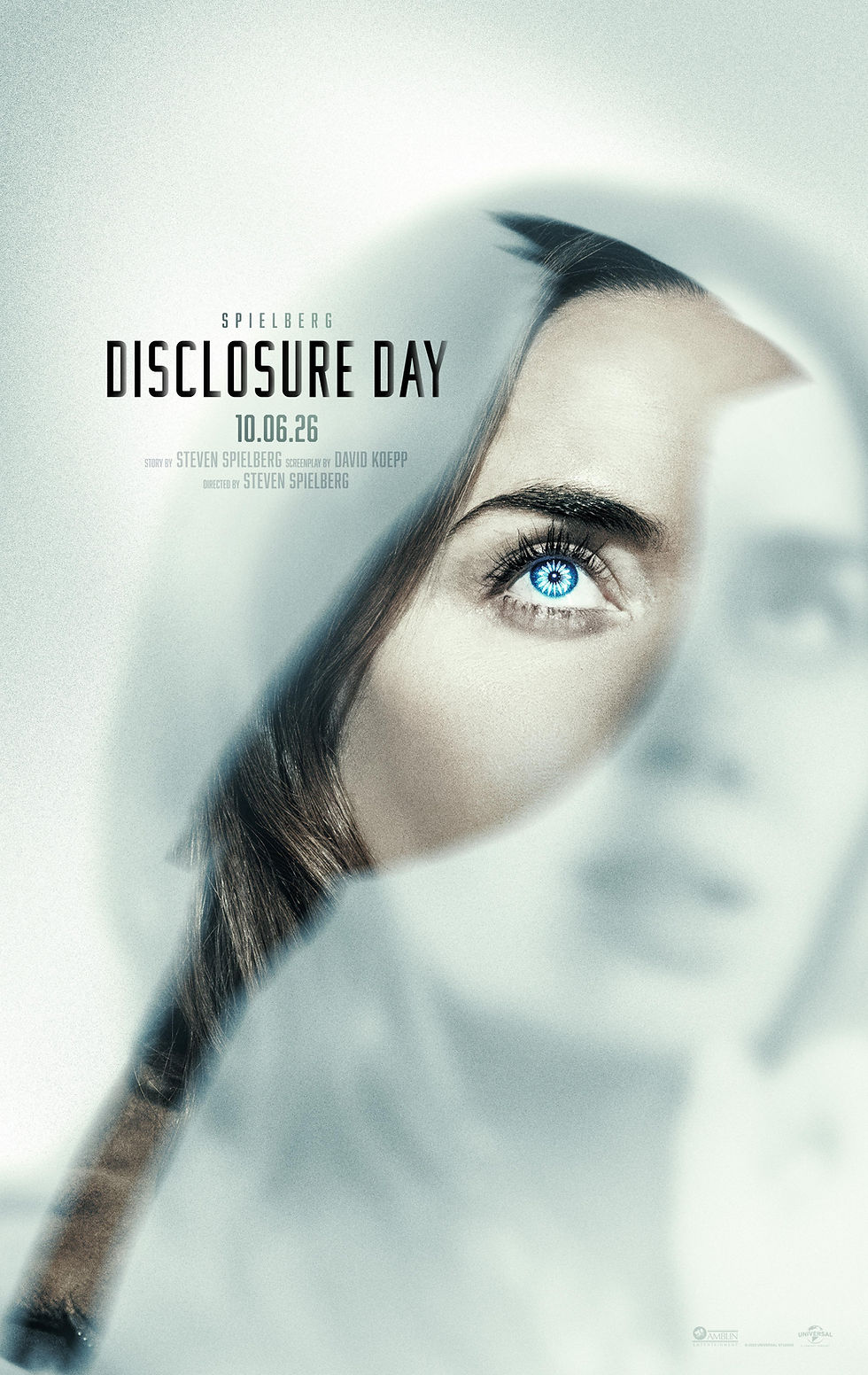
Despite a varied career making iconic films across genres and mediums, Steven Spielberg appears most comfortable and at ease within science fiction, and more specifically with films about aliens. Two of his earliest films, Close Encounters of the Third Kind (1977) and E.T. the Extra-Terrestrial (1982), are among the most famous in his filmography, and he has revisited that territory in films like War of the Worlds (2005) or, in a more oblique way, Indiana Jones and the Kingdom of the Crystal Skull (2008). After having slowed his filmmaking pace considerably (two films in the last nine years), the American master has decided to return to his familiar alien trappings in Disclosure Day (2026).
Disclosure Day follows an attempt to leak the existence of extraterrestrials to the public against the government's wishes. Daniel Kellner (Josh O'Connor), a key leaker, is on the run with crucial information from the clandestine government agency WARDEX, headed by the ruthless Noah Scanlon (Colin Firth). In parallel, Margaret Fairchild (Emily Blunt), a weather reporter for an NBC affiliate in Kansas City, starts developing strange abilities, such as speaking languages she has never studied fluently and even uttering guttural, clicking sounds on-air, which alarms both WARDEX and the leaking organization Daniel works for, headed by the unflappable Hugo Wakefield (Colman Domingo).
The film marks the first collaboration between screenwriter David Koepp and Spielberg since Indiana Jones and the Kingdom of the Crystal Skull. Both seem to steep themselves in the nostalgic storytelling style and structure of Spielberg's earliest work, which was always enraptured with curiosity and wonder. The clearest blueprint appears to be Close Encounters of the Third Kind, to the extent that Disclosure Day feels almost like a remake of it. Both feature human characters who become fixated on a message from aliens that they alone are receiving, and who, despite government efforts at suppression, come to believe they must find answers for themselves and for the world.
While Close Encounters was a more compact film in how it examined a single man and the effect this new obsession had on his fracturing family (itself a reflection of Spielberg's own childhood), Disclosure Day makes use of a larger budget and technological advances to expand its scope in turn. Yet herein lies one of the film's missteps: by taking a greater distance and assembling a more crowded cast, it dilutes the character depth and emotional investment in their journeys. There is no obvious reason why Daniel and Margaret couldn't have been condensed into a single protagonist, which would have allowed the film to delve deeper and spend more time developing that character. Instead, everything feels bigger more for its own sake than for any particular reason, and as a result the attachment to the narrative stems more from sci-fi curiosity than from caring much about any of the characters.
This shallow approach also affects the performances, which, while inhabited by talented actors, are left miming a single emotion apiece. Blunt maintains a breathless deer-in-headlights expression for the entire runtime, O'Connor plays a monotone paranoia throughout, and even the reliably great Firth is reduced to little more than dull grumbling of all his lines. Ironically, this works against the film's central theme. That theme isn't a commentary on the Epstein files, nor a soft launch of actual alien disclosure, as some online conspiracy theorists have suggested, but rather an argument that our distrust of human connection stems from a fractured and insular sense of truth. Spielberg and Koepp propose that rediscovering a shared truth would be enough to help bridge the divides that have grown so deep, but they dress this idea up in a fun sci-fi premise. Yet the irony is that the commonalities of humanity are nowhere to be found in the stark caricatures that populate the film.
Even with a weaker script and constrained performances, Spielberg maintains a level of craft that is undeniable. The director and his team seem incapable of making a bad-looking film, even if they tried. The camerawork, editing, costuming, stunt work, and even the score by the now-unretired John Williams are all undeniable in their meticulous craft, and together help reinforce the nostalgic register that Disclosure Day brings to Spielberg's body of work. It genuinely feels, in the best possible way, like watching a film from decades ago.
In the end, Disclosure Day is a competently made alien movie, one that is practically a remake of Close Encounters of the Third Kind, yet also one that is more diluted and flatter than that 1977 classic. As an example, while in Close Encounters, the aliens communicate through music, a brilliant idea that shows a common language that all emotional beings possess, Disclosure Day has them communicate through the worn-out concept of math, instead. While Spielberg retains flashes of brilliance and his childlike sense of wonder, you are more likely to come away wanting to revisit his earlier alien films than to give this one a second viewing once you walk out of the theater.
6.9/10

Comments