


Backrooms

A Prodigious Debut That Trusts Its Mystery More Than Its Message
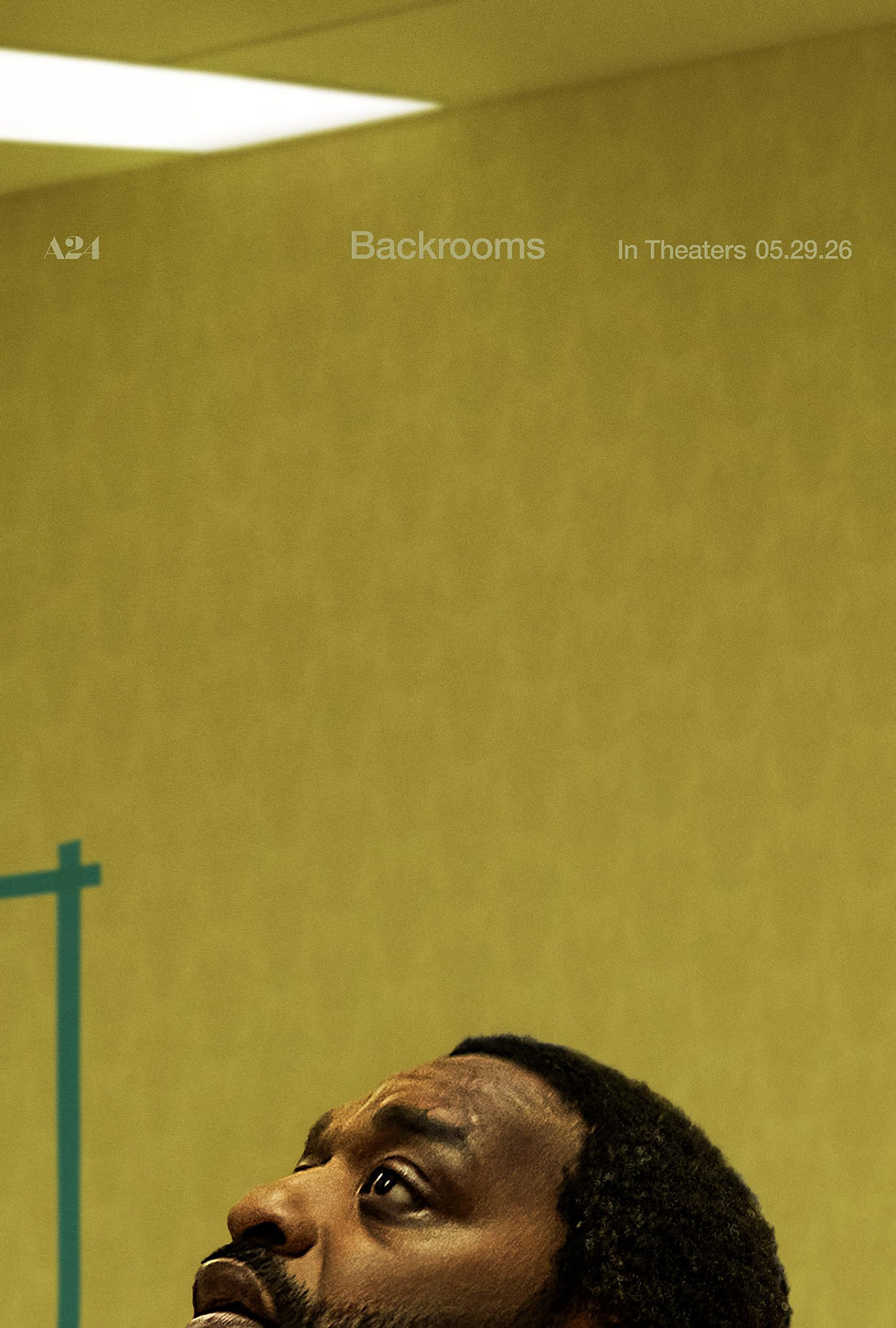
As filmmaking equipment and software have become more accessible, and platforms for content distribution such as YouTube cheap and easy to use, it's surprising it has taken this long for a class of YouTube filmmakers to make the jump to the big screen. The last year has seen creators such as Chris Stuckmann, Mark Edward Fischbach, and Curry Barker debut feature films that showcase an adeptness with the medium and have studios perking up their ears at this overlooked bench of cheap and young filmmakers. Yet the biggest splash of this new crop is 20-year-old Kane Parsons, who was chased by a studio rather than pitching himself, to turn his creepy YouTube videos into the horror film Backrooms (2026).
Backrooms is a mystery-box film wherein a failed architect and furniture salesman, Clark (Chiwetel Ejiofor), in 1990 in Santa Clara finds that by stepping through a wall in his store's basement he enters a strange maze of yellow-wallpapered rooms. This eerie space seems to twist and turn into oblivion, featuring random, half-sunken furniture and objects, with a geometry and architecture that is just slightly off. Clark, who is depressed and lonely, attempts to convince his therapist Mary (Renate Reinsve) of his incredible discovery, but when she doesn't believe him he ventures into this world himself. Yet, he might not be alone in those hallways.
This is Parsons' first feature film, and while he began shooting almost straight after graduating high school, the technical and acting adeptness on display is astounding. It can be tempting to attribute these successes to the more experienced crew and cast, yet a director is the key component in making sure all these different teams work together to form a cohesive whole, and Parsons showcases a clear fluency in the language of film, so that Backrooms feels like an authored project.
From its first scene, Backrooms grabs viewers' attention, using multiple filmmaking techniques and playing with expectation and anticipation. The use of grainy camcorder and POV footage brings a further element of claustrophobia and immersion, making viewers feel as trapped in this perspective as the characters within the hallways. The use of sound, too, gives you the faintest of muffles that will have you paranoid about whether that was a sigh or an unfamiliar footstep. The elements of tension and fear are dialed to perfection by Parsons, who plays with his audience as he wishes.
Building a narrative around a mystery-box concept, where the plot revolves around a central mystery, is an extremely risky proposition. While it is likely to rivet audiences keen to know the answers, if you keep building with more mysteries and inexplicable occurrences you are setting viewers up to be disappointed if these aren't all answered satisfactorily (just ask J.J. Abrams). That risk is present in Backrooms, where the mysteries and oddities become a toxic allure and you begin to wonder how they will all be threaded together. The answer is a blunt translation of the symbolism involved, which permits a cop-out of explaining it all away.
The heavy-handed exposition of what the backrooms represent is hammered home repeatedly as a metaphor for the human mind. It is spelled out with extreme hand-holding in an early scene, where Mary explains that wounded people begin to throw up walls against the outside world and then get lost within their own protected maze. And then again through audiobooks, direct conversations, and various exposition dumps toward the end. While this doesn't diminish Backrooms or the curious puzzle of the human mind it portrays, the redundant explanations do become tiresome, as Parsons seems afraid that someone will miss the point of the film.
With that loss of trust, you also lose the hints and references littered throughout that would guide you toward solving the mystery yourself: the nod in the yellow wallpaper to Charlotte Perkins Gilman's short story "The Yellow Wallpaper"; the references to Daedalus and how his labyrinth was made so complex to contain a monster that even its architect couldn't navigate it; and the production design references to M.C. Escher and his lithograph Relativity. These could have been winks to eagle-eyed and patient viewers in a more restrained film that trusted its viewers, yet they fall by the wayside as mere Easter eggs given the more overexplained version we receive.
The true champion of Backrooms is the production design, which goes above and beyond in creating real sets that truly feel like cubism meeting suburban ennui. I can already imagine the escape rooms being crafted in its image. They prove absolutely crucial to the story, both thematically and almost as a character. The premise is a simple one of empty rooms, yet it is the choices within them that count: an incongruous wall, a pile of broken chairs, or a tiny door fitted with three doorknobs. Every element unsettles viewers, making them shift in their seats as an everyday object is placed in an unnerving manner.
Parsons assembles a talented cast for his first feature, and while Ejiofor and Reinsve are solid in their roles, you can sense that the film is more focused on its mystery-box element than on showy or meaty scenes for them. A climactic exchange toward the end has them interacting more awkwardly than cathartically, leading to a slight dampening of the central message of confronting one's inner walls.
As with any mysterious threat, the more you find out about it the less scary and intriguing it becomes, and while the answers in Backrooms aren't necessarily disappointing, they can't live up to the incredibly tense mystery that preceded them. A lot of mystery is also left in the air, whether because of the juicy potential for sequels or because Parsons wants to suggest that one will never fully uncover all the mysteries of the mind. I suspect a bit of both.
For a debut feature it is as strong a calling card as one could ask, with Parsons showcasing a prodigious talent behind the camera. The central mystery remains intriguing, but while its overexplained themes may dull the film's edge for some viewers and the finale provides answers that can't quite live up to the heightened expectations, Backrooms is still a gripping and refreshingly time at the movies.
7.5/10

Comments